

Funeral Flowers Delivery: A Practical Singapore Guide for Every Occasion
by Summers & Winters on Sep 10, 2026

Choosing funeral flowers delivery is rarely just a matter of selecting something attractive. You may be trying to send condolences to a family you cannot visit, arrange a flower stand for a wake, or coordinate flowers while relatives are handling practical matters. The decision this guide helps you make is simple: what should be sent, where should it go, and how can it arrive respectfully without creating extra work?
Table of Contents
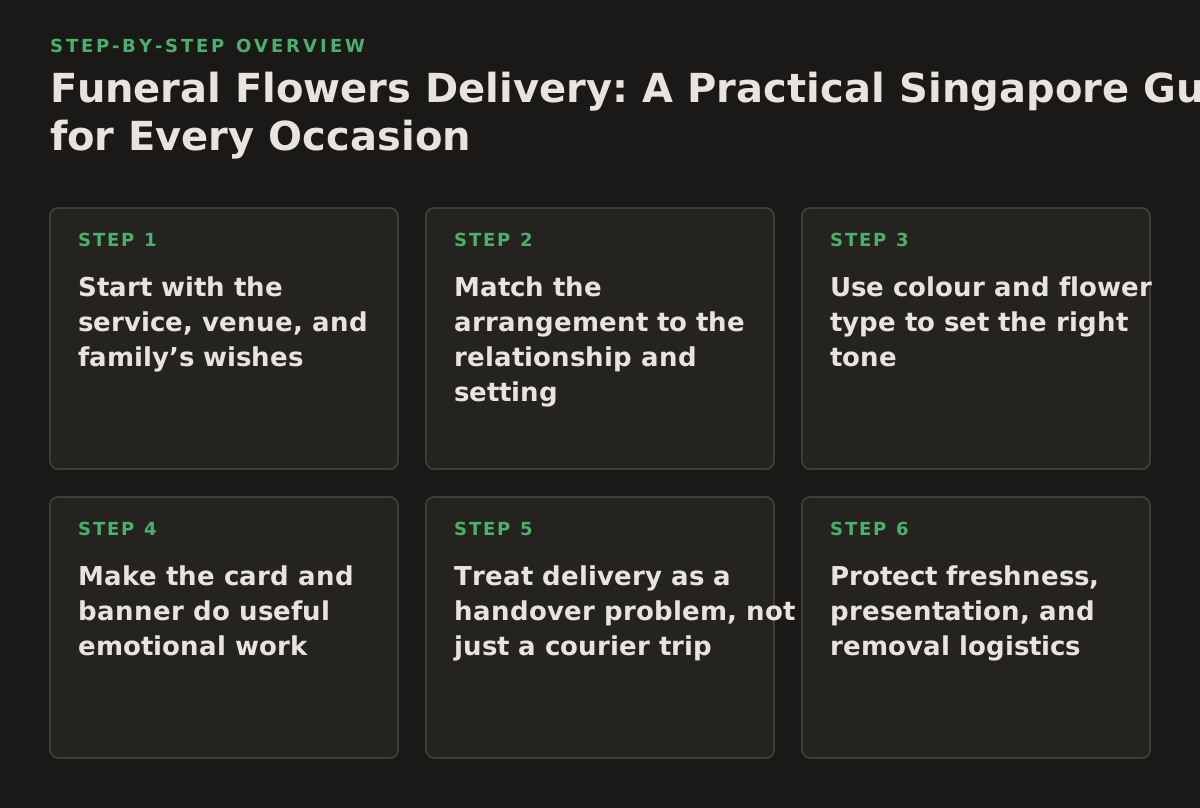
- 1. Start with the service, venue, and family’s wishes
- 2. Match the arrangement to the relationship and setting
- 3. Use colour and flower type to set the right tone
- 4. Make the card and banner do useful emotional work
- 5. Treat delivery as a handover problem, not just a courier trip
- 6. Protect freshness, presentation, and removal logistics
- 7. Use a decision matrix instead of choosing by appearance alone
- 8. Extend the same discipline to other floral occasions
- Implementation plan: place a respectful order in the right sequence
The right choice depends on the service, the relationship, the venue, the timing, and whether the family has expressed any preferences. A restrained sympathy bouquet may suit a colleague’s family, while a large standing arrangement may be more appropriate from a company or extended family group. The same florist may also help with wedding flowers, congratulatory stands, birthday bouquets, preserved designs, and seasonal gifts, but condolence orders require a more careful process.
1. Start with the service, venue, and family’s wishes
When it applies: Use this principle whenever you are ordering for a wake, funeral service, memorial gathering, cremation, or private family farewell. The most important information is not the flower colour. It is the delivery instruction.
Singapore funeral arrangements can involve different venues and schedules, and the family may be moving between a funeral parlour, place of worship, residence, or crematorium. The Singapore Government’s guidance on what to do after a death covers practical administrative steps and points families towards official processes, including registering a death and making funeral arrangements. Check the current guidance rather than relying on an old message chain: Singapore Government guidance on what to do when someone dies.
For a flower sender, this means obtaining the exact venue name, delivery window, and deceased person’s full name before placing the order. A general address such as “the wake at a church” is not enough when several events may be taking place nearby.
Information to confirm before ordering
- The full name of the deceased person, including the spelling for the card or banner.
- The venue’s name, complete address, level, unit, and any block or hall number.
- The date and time of the wake, service, or gathering.
- The name and mobile number of a family member, funeral director, or venue contact.
- Whether the family has requested donations, no flowers, a specific colour, or a particular religious custom.
- Whether the arrangement must be collected or removed by a specific time.
Why it works: A florist can plan the route and presentation around confirmed information. The family is less likely to receive a call asking them to identify an unknown delivery or explain where a stand should be placed.
Failure mode: Sending to the deceased person’s home without checking the wake venue. This can result in a missed handover, a delayed display, or an arrangement arriving after the family has left.
Implementation example: Before ordering, send one concise message to the organiser: “May I confirm the wake venue, the preferred delivery date, and whether the family is accepting flowers?” Save the reply and copy the venue details exactly into the florist’s order form. If the family has not replied, ask the funeral director or another organiser instead of guessing.
2. Match the arrangement to the relationship and setting
When it applies: This principle is useful when you are deciding between a condolence bouquet, flower box, wreath, standing arrangement, or a smaller table display.
The format communicates the sender’s relationship and practical intention. A hand-tied bouquet is personal and easy to place in a home or private gathering. A standing arrangement is visible from a distance and can represent a family, department, association, or business. A compact arrangement may be more suitable where space is limited or where the family has requested restraint.
For group or corporate condolences, the sender’s name must be immediately clear. A stand signed only “Management” may leave the family uncertain about which organisation sent it. Use the registered business or department name, followed by a short message. For personal orders, the names of the sender or family group should be legible without making the card crowded.
Practical format guide
- Condolence bouquet: suitable for a close friend, colleague, neighbour, or smaller private gesture.
- Standing arrangement: suitable when a family, company, school, club, or larger group wants a visible tribute at a wake.
- Wreath: suitable when the family or tradition commonly uses a circular tribute and the venue can accommodate it.
- Table arrangement: suitable for a reception table, memorial display, or home setting where floor space is limited.
- Preserved or dried design: suitable only when the family would appreciate a lasting keepsake and the arrangement fits the tone of the tribute.
Why it works: The arrangement’s scale and placement are aligned with the social purpose. A company can be represented respectfully without sending an oversized design to a small home gathering.
Failure mode: Choosing the largest display because it appears more generous. An arrangement that blocks walkways, signage, or a condolence table creates a practical problem rather than a stronger tribute.
Implementation example: If six colleagues are sending condolences to a former teammate’s family, choose a modest standing arrangement and sign it “Your colleagues at [company name].” If you are a close friend sending to the family home, choose a bouquet with a handwritten card and confirm whether someone will be there to receive it.
When the family has not specified a format, browse a dedicated collection of flower stands for the visual difference between a floor display and a smaller floral gift before asking for a recommendation.
3. Use colour and flower type to set the right tone
When it applies: Use this principle when the ordering page offers many colours or when you are unsure whether a bright, romantic, or highly decorative style is suitable.
There is no single universal funeral palette. White, cream, green, soft pink, lavender, and muted yellow can all work depending on the family, faith, age of the deceased, and relationship. Some families may welcome a favourite colour or a vivid arrangement that reflects the person’s personality. Others may prefer a quiet, neutral design.
The practical rule is to select calm rather than theatrical unless you know the family would value something more expressive. Avoid treating colour symbolism as a fixed law. A red rose arrangement may be suitable from a spouse or immediate family member, but it can feel overly romantic from a business or distant acquaintance. Bright tropical flowers may be meaningful for someone who loved them, yet inappropriate if the venue or family has asked for simplicity.
Questions that resolve uncertainty
- Did the deceased have a favourite flower or colour?
- Is the sender a spouse, child, close friend, colleague, client, or organisation?
- Will the arrangement be displayed beside many other stands?
- Does the venue have a formal or religious atmosphere?
- Has the family asked for donations instead of flowers?
Why it works: The design reflects the person and the relationship instead of relying on a rigid “funeral colour” rule. It also leaves room for cultural and family preferences.
Failure mode: Adding romantic details, novelty accessories, or an elaborate message when the sender’s relationship does not justify them. The design may attract attention for the wrong reason.
Implementation example: For a school sending condolences after a teacher’s death, request white and soft green flowers with a small accent in the teacher’s known favourite colour. For a close friend who loved sunflowers, ask whether a restrained sunflower arrangement would be welcomed rather than assuming a formal white design is the only respectful option.
If the family has asked for a specific flower, tell the florist before choosing a fixed design. Substitutions may be necessary when a particular flower is unavailable, but the requested colour, shape, or feeling can often still guide the arrangement.
4. Make the card and banner do useful emotional work
When it applies: This principle applies to every sympathy order, especially corporate stands where a short message must represent several people.
A condolence message does not need to explain the death, offer advice, or make the family respond. It should acknowledge the loss and identify the sender. The strongest wording is usually brief, sincere, and specific enough to show who is offering support.
Reliable message structure
- Open with a direct expression of sympathy.
- Add one sentence of support or remembrance if appropriate.
- Close with the sender’s name or group.
With deepest condolences to the Tan family. May the memories of Mr Tan bring comfort during this difficult time. From the Lim family.
Our sincere condolences to the family of Ms Lee. She will be remembered with great respect by all of us at [Company Name].
Why it works: The family can understand the message quickly, and the sender is identifiable even when several arrangements are displayed together.
Failure mode: Using a generic phrase without checking the name, relationship, or spelling. A misspelled name on a large banner is difficult to correct and can cause avoidable distress.
Implementation example: Ask one person to approve the final text before sending it to the florist. Keep the message under the florist’s stated character limit, and confirm whether the banner will display the sender on one line or multiple lines. For a bilingual family, request the desired language or provide both versions only if the layout remains legible.
Words to avoid unless the family uses them first
- “Everything happens for a reason.”
- “You need to be strong.”
- Detailed references to the cause of death.
- Religious assurances that may not match the family’s beliefs.
- Humour or informal nicknames without approval from someone close to the family.
For a business, do not turn the card into a marketing message. The company name is useful for identification; a product slogan, sales line, or promotional logo is not appropriate in a condolence setting.
5. Treat delivery as a handover problem, not just a courier trip
When it applies: Use this principle when the order must arrive at a wake, service, hospital-adjacent venue, residence, or event with restricted access.
Fresh flowers are time-sensitive, and a funeral venue may be busy, crowded, or subject to access rules. The delivery plan should therefore include a named contact and an escalation route. Ask the florist how the recipient will be contacted if the venue cannot accept the arrangement immediately.
For a wake, delivery before the main visiting period is usually a sensible starting policy, but it is not a universal guarantee. The appropriate window depends on the florist’s route, the venue’s access, and the family’s schedule. If the order is important to a ceremony, communicate the required arrival time clearly and ask whether the florist can accept that request.
Delivery brief to provide
- Venue name and complete address.
- Wake or service date and the requested arrival window.
- Contact person and mobile number.
- Instructions for security, loading bays, lifts, or reception desks.
- Whether the arrangement should be placed inside, outside, or with other tributes.
- A backup contact if the primary contact cannot answer.
Why it works: The florist can make decisions quickly when the venue is difficult to access. The family does not need to solve a delivery problem while receiving visitors.
Failure mode: Providing only the recipient’s phone number. The recipient may be grieving, asleep, travelling, or unable to answer during prayers or the service.
Implementation example: For a Saturday afternoon wake, request delivery earlier in the day, provide the funeral director’s contact where possible, and ask for a delivery confirmation. If the venue changes, update the florist immediately rather than assuming the original order will be redirected.
For operational checks, a business sender can maintain accurate contact and location details in its own records. Google’s official Business Profile guidance explains how businesses can edit core information such as address, hours, and phone details: Google Business Profile information guidance. This is relevant when a company is coordinating repeated deliveries to its office, showroom, or event venue, but it does not replace confirming the funeral venue directly.
6. Protect freshness, presentation, and removal logistics
When it applies: This principle matters for fresh bouquets, standing arrangements, wreaths, and any tribute that will remain on display for several hours or days.
Fresh flowers need sensible handling after arrival. The Royal Horticultural Society advises keeping cut flowers away from direct heat and sunlight, using clean water, and removing foliage that would sit below the water line. Its cut-flower guidance provides a useful reference for basic care: RHS guidance on using cut flowers.
A standing arrangement may not need the same care as a vase bouquet, but it still needs a stable location away from hot equipment, strong afternoon sun, and narrow walkways. If the display includes floral foam, ask the venue or family who will monitor its condition and when it should be removed.
Care and placement checklist
- Keep bouquets upright during transport and handover.
- Place vase arrangements on a stable, level surface.
- Keep fresh flowers away from direct sun, strong fans, and heat sources.
- Do not place stands where visitors, children, or mobility aids may collide with them.
- Confirm whether the venue will dispose of, return, or allow collection of stands and containers.
Why it works: Good placement preserves the arrangement’s appearance and reduces the chance of spills, blocked access, or damaged flowers.
Failure mode: Treating delivery as the end of the job. A beautiful arrangement placed beside a hot entrance or in a narrow corridor may deteriorate or become a hazard.
Implementation example: If the wake is held outdoors or in a warm foyer, request a design and placement that can tolerate the setting, and ask the venue where flower stands should be grouped. If the family is travelling after the funeral, ask in advance whether they want to keep a bouquet, arrange collection, or let the venue manage removal.
For customers who want a remembrance that does not depend on a short display period, preserved, dried, soap, or faux flowers may be considered for the home. They are not automatically more appropriate: confirm that the family wants a lasting object and that it suits the tone of the occasion.
7. Use a decision matrix instead of choosing by appearance alone
When it applies: Use this framework when several people are contributing, when the order is urgent, or when you are comparing a bouquet with a stand or lasting arrangement.
Score each option against the actual job. This avoids the common mistake of selecting the most attractive product before checking whether it fits the venue, relationship, or delivery requirements. The scores below are a starting policy for decision-making, not a universal industry benchmark.
| Decision factor | Question to ask | Low-risk choice | Illustrative priority |
|---|---|---|---|
| Relationship | Who is the sender to the deceased or family? | Bouquet for personal contact; stand for a group | High |
| Venue space | Can the venue safely display a floor arrangement? | Compact bouquet or table design | High |
| Timing | Can the florist reach the venue within the useful display period? | Order early with a confirmed contact | High |
| Family preference | Were colours, flowers, donations, or no-flower requests specified? | Follow the request | Highest |
| Message | Can the sender be identified clearly? | Short card or banner with approved names | High |
| Aftercare | Who will maintain, keep, collect, or remove it? | Confirm responsibility before dispatch | Medium |
How to apply the matrix
- Remove any option that conflicts with the family’s request.
- Remove options that cannot fit the venue or delivery window.
- Choose the format that best represents the sender’s relationship.
- Approve the message and spelling before payment.
- Confirm handover, placement, and removal instructions.
Why it works: It prioritises constraints that cannot be fixed later, such as a prohibited display format or a missed service. Aesthetic preferences are considered after practical risks are removed.
Failure mode: Giving every factor equal weight. A preferred colour should not outweigh a family request for no flowers, and a lower price should not outweigh an impossible delivery window.
Implementation example: A company wants to send condolences to an employee’s family. The family has accepted flowers, the venue has floor space, and the delivery window is confirmed. A standing arrangement with a restrained palette and a clearly printed company name is likely to perform the job better than six separate bouquets, which may be harder to place and identify.
8. Extend the same discipline to other floral occasions
When it applies: This principle helps businesses, families, and couples who order flowers for several occasions and want one reliable process rather than a different set of mistakes each time.
The key variables remain consistent: recipient, setting, timing, message, format, and aftercare. What changes is the emotional purpose. Birthday flowers can be bright and personal. Anniversary flowers may be romantic. A grand-opening stand should make the sender identifiable to visitors. Bridal flowers must coordinate with attire, venue, ceremony timing, and the couple’s design brief. Seasonal orders for Mother’s Day, Christmas, graduation, or Teacher’s Day may require earlier coordination because the recipient and delivery window are fixed.
Use occasion-specific design rules rather than treating every order as interchangeable. A condolence arrangement should not look like a congratulatory stand, and a wedding bouquet should not be selected solely because it resembles a popular gift bouquet.
Reusable briefing template
- Occasion and emotional tone.
- Recipient or host name.
- Preferred flower, colour, or style.
- Venue and delivery constraints.
- Card, banner, or signage wording.
- Fresh, preserved, dried, soap, or faux flower preference.
- Budget or design limits, labelled as the customer’s own starting range.
- Who approves substitutions or changes.
Why it works: The florist receives a complete brief and can make appropriate substitutions without losing the intended message. It also helps a corporate administrator coordinate condolence stands, opening flowers, and client gifts consistently.
Failure mode: Reusing a previous order without checking the new venue, recipient, or tone. A design that suited a showroom opening may be visually wrong for a quiet memorial gathering.
Implementation example: A Singapore business keeps one internal order template but selects a different format for each occasion: a restrained stand for condolences, a branded-but-not-promotional display for an opening, and compact seasonal bouquets for client gifting. The template remains stable; the emotional brief changes.
Implementation plan: place a respectful order in the right sequence
Use the following sequence for a 2026 order, especially when several relatives or colleagues are coordinating at short notice.
- Confirm the family’s wishes. Ask whether flowers are welcome, whether donations are preferred, and whether any colours, flowers, or religious considerations should guide the design.
- Confirm the venue. Record the full address, wake or service date, requested delivery window, and a contact who can receive the arrangement.
- Choose the format. Select a bouquet for a personal gesture, a stand for a visible group tribute, or a compact design where space is restricted.
- Write the message. Keep it sincere and short. Check every name, title, spelling, and sender detail before approval.
- Brief the florist. Include the arrangement type, preferred tone, venue instructions, contact details, and any acceptable substitutions.
- Confirm the handover. Ask how delivery will be acknowledged, where the arrangement should be placed, and what happens if the venue cannot accept it immediately.
- Plan aftercare. Decide whether the family keeps the flowers, the venue manages removal, or the florist should arrange collection where available.
- Save the final details. Keep the order confirmation, message, delivery instructions, and contact information together until the service has ended.
This process also works for birthdays, anniversaries, bridal flowers, corporate gifts, seasonal collections, and grand-opening displays, with the message and design adjusted to the occasion. Summer’s Winter Florist can help with fresh arrangements, lasting floral styles, customised orders, and Singapore-wide delivery; browse flower bouquets when a bouquet is the right personal format, or contact the team through Summer's Winter Florist for help matching the arrangement to the venue and occasion.
Authored with NotFair SEO


