

Bridal Bouquet Fresh Flowers: A Practical Singapore Wedding Guide
by Summers & Winters on Sep 11, 2026

Choosing bridal bouquet fresh flowers is not simply a matter of picking the prettiest blooms in a colour palette. The bouquet must suit the wedding outfit, survive its handling schedule, fit the ceremony setting, and still look intentional when photographs are taken later in the day. For couples ordering in Singapore, a useful decision starts with flower behaviour, not just appearance: how delicate is the stem, how much water does it need, how long will it be out of refrigeration, and what happens if a particular variety is unavailable?
Table of Contents
- What “Bridal Bouquet Fresh Flowers” should mean
- Why flower choice matters more than a colour swatch
- How a customised fresh bridal bouquet order works
- Where fresh bridal bouquets break down
- How practitioners apply the brief on the wedding day
- A specific recommendation for ordering in Singapore
What “Bridal Bouquet Fresh Flowers” should mean
The phrase describes a hand-held wedding arrangement made from recently prepared, living cut flowers rather than preserved, dried, soap, or faux materials. “Fresh” does not mean that every flower was cut on the wedding morning. It means the stems are being managed as perishable botanical material: hydrated, conditioned, protected from damaging temperatures, and presented within a planned use window.
A bridal bouquet is also more specific than an ordinary gift bouquet. It needs a comfortable carrying shape, a stem finish that will not snag clothing, a silhouette that works from several camera angles, and enough structural control to remain attractive while the bride walks, stands, hugs, and poses. A gift bouquet may be designed mainly for delivery and display. A bridal bouquet must perform in the hand.
The four decisions hidden inside the request
- Style: round, hand-tied, cascading, airy garden-inspired, compact posy, or another silhouette.
- Palette: one dominant colour family, a soft mixed palette, strong contrast, or a design matched to the attire and venue.
- Flower behaviour: sturdy focal blooms, flexible supporting flowers, textural fillers, foliage, and any fragile accents.
- Logistics: collection or delivery, ceremony time, photography schedule, venue access, and whether the bouquet needs to be carried outdoors.
These decisions should be made together. A loose, airy design may look excellent with a flowing dress but can expose delicate petals to movement and weather. A compact bouquet may travel more securely but feel visually heavy against a structured gown. A pale palette can look refined yet show bruising, water marks, or pollen more readily than a deeper mixed palette.
Fresh, preserved, dried, and faux are different purchases
Fresh flowers are the right choice when the couple wants natural scent, living petals, and the visual softness associated with a wedding-day bouquet. They are also the least forgiving option. Preserved and dried flowers are more suitable when the bouquet must be kept as a long-term memento, while soap or faux flowers can suit décor, repeated use, or a design that cannot depend on a narrow freshness window.
That distinction matters when a couple says “I want the bouquet to last.” They may mean “look good through the ceremony,” or they may mean “remain recognisable for years.” Those are different objectives. A fresh bouquet can be handled carefully for the event and then photographed, dried, or partially preserved afterwards, but it should not be promised the same lifespan as a preserved arrangement.
Why flower choice matters more than a colour swatch
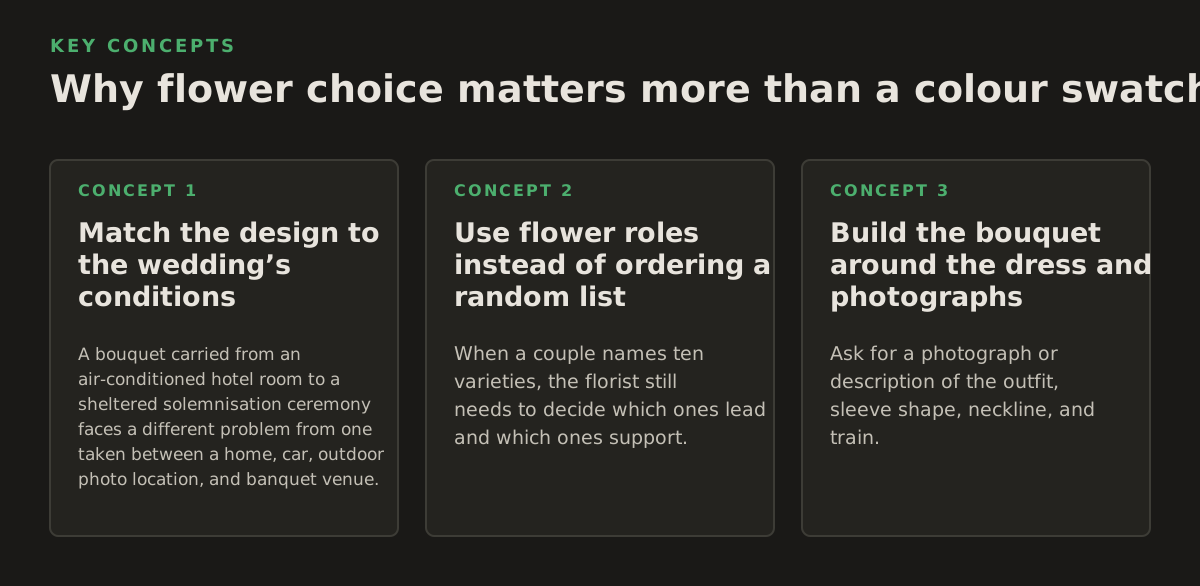
Colour is visible at the ordering stage; durability is revealed during use. A florist therefore has to balance visual roles with physical roles. The focal bloom supplies scale and attention. Secondary flowers fill gaps or soften transitions. Foliage frames the outline. Small flowers and texture prevent a monochrome design from looking flat. Each component also brings its own stem strength, water demand, petal sensitivity, and response to handling.
Match the design to the wedding’s conditions
A bouquet carried from an air-conditioned hotel room to a sheltered solemnisation ceremony faces a different problem from one taken between a home, car, outdoor photo location, and banquet venue. Singapore’s climate is generally warm and humid, and the Meteorological Service Singapore describes the country’s equatorial climate and consistently high humidity on its official climate page: Singapore climate information. That does not make every fresh flower unsuitable, but it makes exposure planning part of the design.
For an indoor ceremony, the florist can usually prioritise the requested look while still selecting flowers with compatible care needs. For an outdoor segment, the safer approach is to reduce the bouquet’s time in direct sun, avoid leaving it in a parked vehicle, and consider a silhouette that does not depend on extremely delicate outer petals. A bouquet that looks loose and romantic in a sample image may need a slightly more controlled construction for real movement.
Use flower roles instead of ordering a random list
When a couple names ten varieties, the florist still needs to decide which ones lead and which ones support. A practical brief identifies the effect first, then uses available flowers to produce that effect. For example, “cream and blush, rounded, softly romantic, not too dense” gives useful design direction even if one requested variety is unavailable.
- Focal role: one to three visually dominant flower types that establish scale and colour.
- Bridge role: medium-sized blooms that connect the focal flowers to the smaller details.
- Texture role: airy flowers, berries, pods, or fine foliage that create movement and depth.
- Frame role: greenery or trailing material that defines the outside edge without obscuring the flowers.
- Finish role: ribbon, wrapped stems, pins, or a discreet protective treatment suited to the dress and carrying method.
As an illustrative starting policy, a compact hand-tied bouquet might be briefed as 3–5 flower roles, rather than a rigid promise of a specific stem count. That is not a universal recipe: the final quantity depends on flower head size, the requested scale, the season, and the bride’s proportions. The point is to communicate design hierarchy so substitutions do not turn the bouquet into an unrelated arrangement.
Build the bouquet around the dress and photographs
Ask for a photograph or description of the outfit, sleeve shape, neckline, and train. A narrow bouquet can disappear against a wide skirt; a broad bouquet can hide detailed embroidery. A trailing shape may echo a long veil, while a compact round bouquet may better suit a tailored dress or a ceremony where the couple wants clear sightlines between them.
Also consider how the bouquet will be held. If the stems are too short, the bride may grip the flowers themselves and bruise petals. If the handle is too thick, the bouquet can become tiring during a long photography session. The handle should be secure without becoming an object that draws attention away from the flowers.
How a customised fresh bridal bouquet order works
A successful order is a sequence of decisions, not a single image sent over chat. The florist needs enough information to assess style, availability, preparation, and delivery. The earlier the brief identifies non-negotiables, the more intelligently the florist can handle seasonal substitutions.
Start with a decision-ready brief
Send the florist the information below in one message. This reduces back-and-forth and exposes conflicts early, such as a delicate design requested for a long outdoor schedule.
- Wedding date and key times: include when the bouquet must be in hand, not only the banquet start time.
- Venue and access details: give the venue name, room or building where relevant, and whether a recipient must meet the delivery person.
- Bouquet style: describe the shape, mood, colour palette, preferred flowers, disliked flowers, and desired size.
- Outfit and setting: share dress colours, suit colours, bridesmaid tones, décor references, and indoor or outdoor locations.
- Delivery requirements: specify the delivery address, acceptable time window, contact person, parking or security constraints, and any handover instructions.
- Substitution tolerance: state whether the priority is exact flower varieties, exact colours, overall shape, or the general mood.
Reference images are helpful, but they should be treated as design references rather than guarantees of identical flowers. A photograph may show a particular season, imported variety, lighting setup, or bouquet size that cannot be duplicated exactly. The useful question is: “What must remain true if the florist has to replace one component?”
Agree on the approval logic
Before confirming, separate fixed requirements from flexible ones. “White and blush, rounded, medium-sized, with a clean ribbon finish” is a flexible brief with clear boundaries. “Exactly this imported flower, with no substitutions, delivered at an unspecified time” is a high-risk brief unless availability and timing have already been confirmed.
A practical approval message can list:
- the agreed colour direction;
- the approximate bouquet scale;
- the intended silhouette and handle finish;
- the flowers that are essential, preferred, or optional;
- the delivery date, address, and requested handover window;
- the process for approving a meaningful substitution.
This matters because substitutions are not merely inventory changes. Replacing a large round flower with a small spray flower changes the bouquet’s scale. Replacing a firm stem with a soft one can change the outline. Replacing a pale flower with a saturated one can shift the whole palette. The best substitution preserves the visual function of the original, not just its colour name.
Plan delivery around use, not convenience
For a wedding bouquet, the requested delivery time should be tied to the getting-ready schedule and the first moment the flowers will be carried. A florist may recommend a delivery window that leaves enough time for inspection and hydration without creating unnecessary hours of exposure. The exact window depends on the venue, route, bouquet construction, and ceremony plan, so it should be agreed directly rather than assumed.
If the bouquet is delivered to a venue, confirm who receives it. A lobby handover, loading-bay handover, bridal-suite handover, and room-to-room handover are not interchangeable. Include a reachable contact person and instructions for security desks or restricted access. These details prevent a good bouquet from waiting unattended in the wrong place.
Where fresh bridal bouquets break down
Most failures are not caused by one dramatic mistake. They come from a chain of small mismatches: a fragile flower selected for a long outdoor period, a bouquet delivered before anyone can receive it, a car used as temporary storage, or a substitution made without explaining the effect on shape.
Heat exposure is a schedule problem
Cut flowers lose quality faster when they are exposed to unsuitable heat, direct sun, or stagnant conditions. The RHS discusses the importance of appropriate handling and conditioning for cut flowers in its guidance on growing and using cut flowers. The practical implication for a wedding is straightforward: protect the bouquet from unnecessary exposure before the bride carries it.
Do not use a parked vehicle as a holding room, even for a short errand. Do not place the bouquet beside a sunny window for photographs before the ceremony. If the venue has a suitable cool indoor space, keep the bouquet there until it is needed, while avoiding rough movement and cramped storage that can crush the outer petals.
Water and handling errors can be invisible at first
A bouquet may look fine at handover and deteriorate later because its stems were squeezed, its petals rubbed, or its water source removed too early. The RHS explains general cut-flower care and arranging considerations in its flower-arranging guidance. That advice is not a substitute for a florist’s instructions for a particular bouquet, but it supports a useful rule: once the bouquet is prepared, limit unnecessary recutting, crushing, and repositioning.
For the person receiving the flowers, the safest response is to follow the florist’s specific care directions. Some bridal bouquets are finished for immediate carrying rather than long-term vase display. A wrapped stem may not be intended to sit submerged, and an arrangement designed with a particular holder may be damaged if dismantled. Ask before changing the construction.
Substitution can solve supply problems while creating design problems
Flower availability can change with season, supplier stock, transport conditions, and quality at the time of preparation. The error is not substitution itself; it is substituting without preserving the intended balance. A florist should consider flower head size, stem length, texture, colour temperature, and the amount needed to maintain the silhouette.
Use this simple decision hierarchy when a requested flower is unavailable:
- First: preserve the bouquet’s overall shape and carrying comfort.
- Second: preserve the dominant colour relationship against the attire and venue.
- Third: preserve the texture or mood, such as airy, lush, sculptural, or garden-like.
- Fourth: preserve the exact variety only when it is genuinely essential to the brief.
For example, if a bride wants a soft, rounded white-and-green bouquet, changing one white focal flower to another white focal flower may be acceptable if the scale and petal character remain compatible. If the bride wants one recognisable flower because it has family meaning, that variety should be marked as non-negotiable and confirmed separately from the flexible supporting flowers.
Timing assumptions cause preventable stress
Wedding days rarely run exactly to the first schedule. A bouquet may be needed earlier for hair and makeup photographs, family portraits, or a first look. Conversely, a late delivery may arrive after the bride has already left for the ceremony. Build the plan around the first required use and the actual handover location.
As an illustrative starting policy, a couple might request delivery before the first portrait block rather than merely before the solemnisation. This is a planning example, not a universal timing benchmark. The correct window should be confirmed with the florist after the route, venue access, bouquet type, and day-of schedule are known.
How practitioners apply the brief on the wedding day
The most useful care plan is short enough for a bridesmaid, planner, or family member to follow. It should identify who receives the bouquet, where it rests, when it is handed over, and what not to do. Responsibility matters because a bouquet can pass through several hands before the bride sees it.
Create a one-page handover plan
- Receiver: name one person responsible for accepting and checking the bouquet.
- Location: identify the exact room or sheltered area where it will wait.
- Inspection: check the ribbon, handle, overall shape, and any visible damaged petals without rearranging the flowers.
- Holding: keep it in the care position recommended by the florist and away from direct sun or a hot vehicle.
- Handover: give it to the bride shortly before the first planned use, unless the photographer or planner has a different schedule.
- Escalation: contact the florist promptly if the bouquet arrives damaged or a delivery problem occurs.
This plan prevents well-meaning but harmful improvisation. Someone may place the bouquet in a vase without checking whether its wrapping or holder is designed for that. Someone else may lay it flat on a makeup table, crushing the lower flowers. A named caretaker reduces those competing decisions.
Use the bouquet as part of the visual composition
The bride should hold the bouquet low enough to show the neckline and high enough that the stems do not point awkwardly toward the floor. For photographs, the bouquet can be angled slightly to reveal its depth rather than held perfectly flat. The photographer or planner can give the final direction, but the florist can help by making the handle comfortable and the front face visually coherent.
Bridesmaids’ bouquets should support, not compete with, the bridal bouquet. They can repeat one colour or texture at a smaller scale, while the bridal arrangement retains the strongest focal flower or most distinctive silhouette. If the wedding party also needs flower bouquets, include those quantities and delivery requirements in the same planning conversation so the designs are coordinated without becoming identical.
Make the venue plan consistent with the floral plan
For a ceremony or reception, the bouquet is only one part of the floral environment. If the couple is also arranging entrance pieces, table flowers, or flower stands, give the florist a shared palette and a clear priority order. A bridal bouquet may need a finer, more personal treatment, while a large stand needs visibility from a distance and a construction suited to its display location.
That distinction is useful for families and businesses involved in the same event. A congratulatory stand, an entrance arrangement, and a bridal bouquet should not be evaluated by the same durability or scale criteria. They can share colours or foliage, but each has a different job and a different viewer distance.
A specific recommendation for ordering in Singapore
For most couples, the safest approach is to brief the florist around shape, colour, carrying time, and delivery handover before insisting on a fixed flower list. Mark one or two flowers as essential if they carry emotional meaning; keep the supporting flowers flexible enough for the florist to preserve the bouquet’s structure and condition.
When you are ready to order, contact Summer’s Winter Florist via WhatsApp and send the wedding date, venue, bouquet style, and delivery requirements in the first message. Add the colour palette, dress references, preferred flowers, outdoor exposure, ceremony time, and your substitution preferences so the florist can advise on a customised fresh bridal bouquet rather than treating the request as a generic gift order.
Summer’s Winter Florist offers fresh bouquets, bridal flowers, customised arrangements, and delivery across Singapore; explore the available floral options and contact the florist to turn the brief into a practical wedding-day plan.
Authored with NotFair SEO


