

Custom Flower Bouquet: How to Plan a Meaningful Arrangement in Singapore
by Summers & Winters on Sep 18, 2026

A custom flower bouquet is an arrangement designed around a recipient, occasion, colour direction, flower preference, and delivery situation rather than selected from a fixed catalogue design. For a birthday, anniversary, condolence message, grand opening, or wedding, give the florist the purpose, preferred palette, useful budget range, size, timing, and flowers to include or avoid; the florist can then translate those decisions into a suitable fresh, preserved, dried, soap, or faux arrangement. The best custom order is not simply “make it beautiful”—it is a clear brief that balances emotion, appearance, seasonality, transport, and care.
Table of Contents
- What a Custom Flower Bouquet actually changes
- Why the brief matters more than the flower list
- How a custom bouquet is planned from brief to delivery
- Where custom orders break down
- How to use customisation for different occasions
- A practical custom-order checklist
What a Custom Flower Bouquet actually changes
A standard bouquet begins with an established recipe: a known flower mix, wrapping style, colour scheme, and approximate silhouette. A custom order begins with the job the flowers need to do. That difference matters because a hand-tied birthday bouquet, a compact office gift, a bridal bouquet for photographs, and a condolence arrangement have different practical requirements.
Customisation can happen at several levels. You may choose one hero flower, request a particular colour family, specify a loose or structured shape, add a card, or ask for an alternative material when fresh flowers are unsuitable. You are not required to decide every stem. In fact, a useful brief often leaves room for the florist to substitute flowers that fit the intended colour, texture, and scale.
The five decisions behind the design
- Purpose: birthday, romance, congratulations, sympathy, corporate appreciation, wedding, or home décor.
- Recipient: their personality, age group, relationship to the sender, and tolerance for scent or maintenance.
- Visual direction: pastel, vivid, neutral, monochrome, tropical, garden-like, minimalist, or formal.
- Format: hand-tied bouquet, boxed arrangement, table piece, bridal bouquet, flower stand, or longer-lasting alternative.
- Practical limits: delivery address, timing, transport, vase availability, allergy concerns, and a stated starting budget.
For example, “something cheerful for my sister” leaves too many decisions open. “A medium, hand-tied arrangement in coral, peach, and cream, with a bright birthday feeling, low fragrance, and delivery to an office reception” gives a florist a workable design problem. If the exact flower is unavailable, the visual and emotional brief still survives.
Custom does not mean every request can be combined
Some preferences conflict. A very large arrangement may not suit a small desk. A delicate, open garden style may not travel as neatly as a compact tied bouquet. A flower-heavy design may feel inappropriate for a formal condolence setting. A low-maintenance gift may be better served by preserved or faux flowers than by fresh stems.
The useful question is therefore not “Can I choose everything?” but which choices matter most. Rank them: recipient’s favourite colour, a meaningful flower, delivery format, overall mood, and then secondary details such as ribbon or wrapping.
Why the brief matters more than the flower list
Flowers communicate through colour, scale, rhythm, scent, and context. A bouquet can contain someone’s favourite flower and still miss the occasion if its proportions or tone feel wrong. A custom brief protects against that mismatch by explaining the meaning behind the request.
For romantic orders, state whether the message should feel tender, celebratory, dramatic, or understated. For an anniversary, mention the year or a shared colour. For congratulations, a bright, upright, generous arrangement may communicate energy better than a muted design. For sympathy, the family’s relationship and the setting matter: a home delivery, memorial service, and workplace condolence may call for different formats.
Match the design to the recipient’s circumstances
| Order situation | Useful custom direction | Potential constraint |
|---|---|---|
| Birthday at home | Recipient’s favourite colours, cheerful focal flower, vase-ready format | Check whether someone will be home to receive and care for fresh stems |
| Office congratulations | Compact arrangement, clear card message, polished rather than strongly scented | Reception desks and shared spaces may have limited room |
| Condolence | Quiet palette, respectful shape, sympathy message, suitable stand or arrangement | Confirm venue, delivery instructions, and whether a standing display is appropriate |
| Wedding bouquet | Silhouette, handle comfort, dress colour, photography needs, and ceremony timing | The bouquet must be carried comfortably and coordinate with the wider wedding flowers |
| Longer-lasting décor | Preserved, dried, soap, or faux flowers selected for the room and maintenance preference | These materials create a different texture and scent experience from fresh flowers |
For Singapore deliveries, include the building name, unit or reception point, contact number, preferred delivery window, and any access instructions in the order brief. A florist may create a beautiful arrangement, but an unclear delivery hand-off can still undermine the gift.
When the occasion calls for a presentation larger than a personal gift, browse the available flower stands as a separate format rather than enlarging a bouquet until it becomes awkward. A stand is designed to be seen from a distance and read as a public gesture, while a bouquet is usually held, displayed on a table, or given directly to one person.
How a custom bouquet is planned from brief to delivery
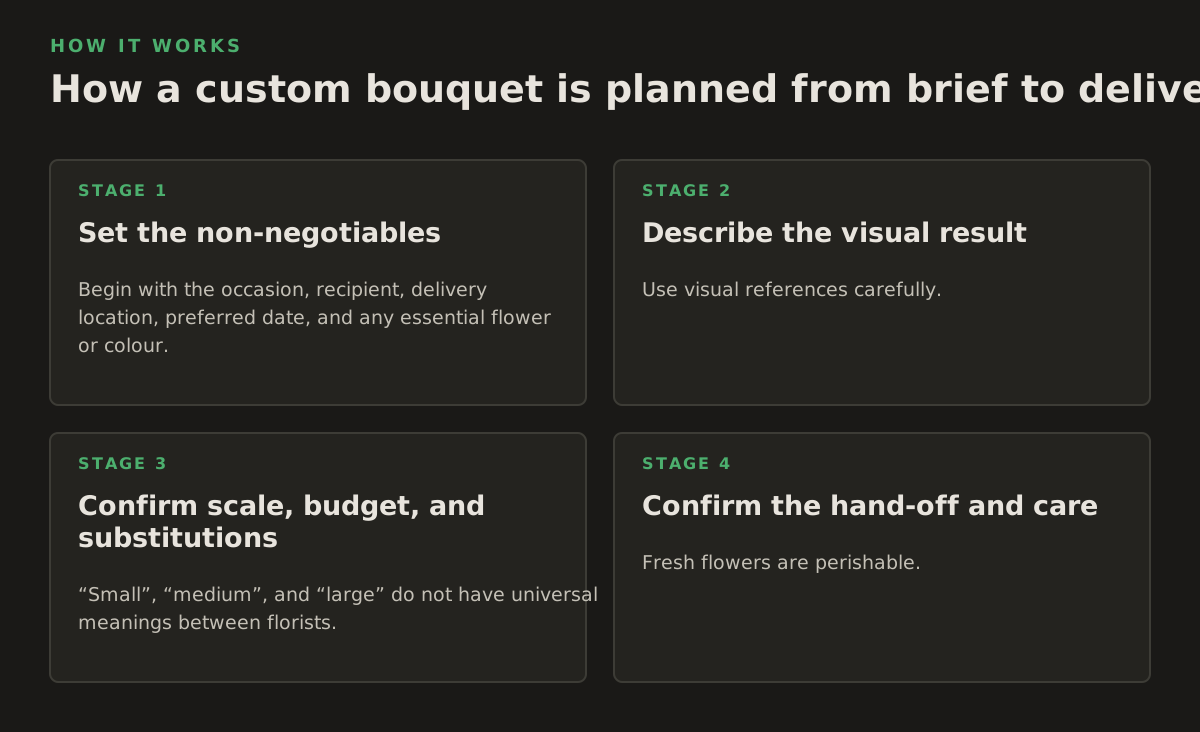
A reliable custom order moves through a sequence. The sequence helps the florist identify what must stay fixed and where substitutions are safe.
Step 1: Set the non-negotiables
Begin with the occasion, recipient, delivery location, preferred date, and any essential flower or colour. If a particular flower carries personal meaning, say so. If the recipient dislikes lilies, strong fragrance, pollen, or a certain colour, say that at the start rather than after the design is proposed.
Then choose the material. Fresh flowers suit immediate celebration and sensory impact. Preserved and dried flowers suit keepsakes or décor where the recipient wants to retain the arrangement. Soap flowers can be decorative and gift-like, while faux flowers can be practical for repeated display. These are not interchangeable versions of the same bouquet; each gives a different texture, care routine, and emotional experience.
Step 2: Describe the visual result
Use visual references carefully. A reference image is useful for mood, shape, and colour, but it should not be treated as a promise that every stem will be identical. Fresh flower availability, maturity, season, and substitution needs can change the final mix.
Useful language includes:
- “Loose and garden-like, with movement around the edges.”
- “Compact and polished for a reception counter.”
- “Mostly white and green, with one soft accent colour.”
- “Bright tropical feeling without a tall, heavy silhouette.”
- “A hand-held bridal bouquet with a comfortable stem length.”
Include a reference for the shape and mood, not only the flowers. A florist can often preserve the intended effect by changing varieties while keeping the colour balance, focal point, and scale.
Step 3: Confirm scale, budget, and substitutions
“Small”, “medium”, and “large” do not have universal meanings between florists. Ask what the chosen size means in practical terms: hand-held, table-centred, desk-friendly, or statement-sized. If you have a budget ceiling, describe it as a starting policy or illustrative range for the design conversation, not as a promise of a fixed stem count.
Agree on a substitution rule. One reasonable policy is: keep the palette and overall feeling if the requested flower is unavailable; contact the sender before changing the colour direction or arrangement format. This prevents a florist from being forced into poor-quality or unsuitable stems merely to replicate a photograph.
For weddings and major corporate occasions, provide a fuller schedule: ceremony or event date, venue, access time, setup requirements, bouquet hand-off time, and the number of arrangements. A wedding bouquet is not planned in isolation if buttonholes, table flowers, ceremony pieces, or a reception display need to coordinate.
Step 4: Confirm the hand-off and care
Fresh flowers are perishable. The Royal Horticultural Society recommends keeping cut flowers away from direct sun and heat and changing vase water regularly; its cut-flower care guidance also covers clean containers and stem preparation. That is why delivery timing, recipient availability, and a suitable display location belong in the brief rather than being treated as afterthoughts.
For a vase arrangement, tell the recipient to use a clean vase, follow the supplied care instructions, and remove foliage that would sit below the waterline. The University of Minnesota Extension explains that clean water and containers help reduce conditions that shorten cut-flower life in its care guidance for cut flowers. Exact longevity still depends on flower type, maturity, indoor temperature, handling, and care.
Where custom orders break down
Most disappointments come from an information gap, not from the idea of customisation. The sender imagines a finished image; the florist receives a vague instruction; the recipient receives something technically attractive but emotionally misaligned.
Failure point: treating a photograph as an exact product
A reference photo may show a particular season, flower maturity, lighting setup, or vase. Requiring an exact copy can create unnecessary substitutions or a design that looks forced. Instead, identify the three visual properties that matter most: perhaps dusty pink and cream, loose movement, and a generous hand-tied shape.
Failure point: ignoring the receiving environment
A tall bouquet may be difficult to carry on public transport. A large arrangement may overwhelm a small apartment table. A strongly scented design may be unsuitable for an office, hospital visit, or recipient with sensitivities. A sympathy stand may require venue coordination, while a bouquet delivered to a private residence requires someone to receive it.
Failure point: asking for “fresh” without discussing care
Fresh flowers provide immediacy, but they need water and suitable placement. A recipient travelling for several days, working long hours, or moving between homes may prefer a preserved or dried design. The University of Missouri Extension notes that flower longevity is affected by factors including cleanliness, water management, temperature, and flower condition in its care information for cut flowers. The practical lesson is to choose the material around the recipient’s routine.
Failure point: leaving delivery details until the last message
Singapore addresses can involve condominium access, office reception, loading zones, security desks, and venue-specific timing. Confirm the complete address and a reachable recipient before the order is finalised. For events, nominate one person to receive or position the flowers. A named contact reduces uncertainty when the delivery point is not obvious.
- Illustrative brief: “A birthday bouquet for a home delivery, peach and yellow, cheerful but not romantic, compact enough for a dining table, card included.”
- Illustrative brief: “Condolence arrangement for a service venue, white and green, restrained and formal, with delivery instructions from the venue.”
- Illustrative brief: “Preserved arrangement for a desk, neutral tones, low maintenance, no strong fragrance, modest footprint.”
- Illustrative brief: “Bridal bouquet for photographs, soft garden style, comfortable to hold, coordinated with white and blush wedding flowers.”
These are starting examples, not universal formulas. The right result depends on the recipient, venue, materials, and florist’s available stems.
How to use customisation for different occasions
Once the brief is clear, the same method can produce very different results.
Personal gifts: make one detail carry the meaning
For birthdays and anniversaries, choose one personal anchor: a favourite colour, meaningful flower, shared memory, or message. Let the surrounding flowers support that anchor instead of adding every possible preference. A custom flower bouquet feels considered when the recipient can recognise why it was made that way.
For romantic gifting, clarify the degree of intimacy. Red is not the only romantic direction; blush, wine, peach, or a restrained neutral palette may better suit someone who prefers understated gifts. For congratulations, a brighter palette and more open shape can make the gesture feel energetic without relying on an oversized arrangement.
Condolences and corporate gestures: prioritise clarity
Sympathy flowers should communicate respect before personal style. Use a calm palette, an appropriate message, and a format that suits the family or venue. For a public condolence gesture, a flower stand may be more visible and formal than a hand-held bouquet. Confirm the spelling of names, the service location, and the sender details because these are part of the message.
For grand openings and corporate gifts, consider sightlines and branding without making the flowers look like advertising. A clean colour direction can echo a brand palette, while a neutral arrangement may work better when several businesses are contributing displays. Ask where the flowers will stand, who will receive them, and how long the display needs to remain presentable.
Bridal flowers: design for movement as well as photographs
A bridal bouquet must work in the hand, not only in a mood board. Discuss handle comfort, bouquet width, dress silhouette, ceremony duration, photographs, and the time between delivery and the event. A loose bouquet may look natural but need careful support; a compact round bouquet may be easier to carry and coordinate with a formal dress.
Bring the wedding palette, fabric details, and any existing floral plan into the conversation. The bridal bouquet should belong to the same visual system as the ceremony and reception flowers while still giving the bride or couple a distinct focal arrangement.
Seasonal and longer-lasting orders: adapt the expectation
Mother’s Day, Christmas, graduation, and Teacher’s Day often create strong demand for recognisable colours and gift-ready presentation. A seasonal custom order does not need to imitate a generic holiday arrangement. Specify whether the recipient prefers festive, elegant, playful, or subdued styling.
For preserved, dried, soap, or faux flowers, design around the room and the expected lifespan of the gift. Ask about dust, sunlight, pets, children, and whether the arrangement will be displayed in a vase, on a shelf, or as a centrepiece. A design that looks beautiful in a photograph may be impractical if it is too tall for the intended shelf or too delicate for the household.
A practical custom-order checklist
Before confirming your order, send the florist a concise brief. A good brief reduces back-and-forth while leaving professional room for flower selection.
- Occasion and message: explain what the flowers should communicate and provide the exact card wording.
- Recipient details: name, preferences, dislikes, scent sensitivity, and whether fresh or longer-lasting flowers suit their routine.
- Design direction: colours, mood, shape, preferred flower, and reference image if available.
- Format and scale: bouquet, box, stand, bridal piece, table arrangement, or décor; describe where it will be placed.
- Delivery information: date, preferred timing, full address, access instructions, recipient contact, and backup contact where appropriate.
- Flexibility: state what may be substituted and what must not change, such as the colour palette or a meaningful flower.
Review the final brief for contradictions. “Large but desk-sized”, “fragrant but scent-free”, and “exactly like the image with no substitutions” are not workable requests without further discussion. Resolve those conflicts before the florist begins.
For inspiration across hand-tied styles and gift formats, explore the available flower bouquets. If your occasion is a grand opening, memorial, or other public presentation, consider flower stands instead of treating a personal bouquet as a miniature display.
The most dependable recommendation is to order by purpose first, design second, and flower variety third. Give Summer's Winter Florist a clear brief covering the occasion, recipient, palette, format, delivery details, and flexibility; its Singapore range includes fresh bouquets, preserved and dried flowers, soap and faux flowers, bridal flowers, stands, seasonal collections, and customised arrangements. Summer's Winter Florist
Authored with NotFair SEO


