

Wedding Flower Bouquets: How to Choose, Order, and Keep Them Fresh in Singapore
by Summers & Winters on Sep 13, 2026

Wedding flower bouquets are hand-tied or arranged floral designs made for a wedding party, usually to be carried by the couple or held during the ceremony and photographs. Unlike an everyday gift, wedding flower bouquets must suit clothing, venue scale, ceremony timing, photography, transport, and the wearer’s comfort at the same time. That is why the prettiest individual blooms are not always the best bouquet choice.
Table of Contents
- What a wedding bouquet actually needs to do
- Why the brief matters more than the flower list
- How wedding bouquets are planned, made, and delivered
- Where bouquet plans break down
- How practitioners apply the method to real wedding orders
- What to ask before placing the order
A useful way to think about a bridal bouquet is as a small piece of event design with a practical job. It frames the person carrying it, supports the wedding colour story, survives a delivery and ceremony schedule, and remains presentable when the flowers are close to warm outdoor air, air-conditioning, makeup, fabric, and constant handling. The right selection therefore begins with decisions, not with a flower name.
What a wedding bouquet actually needs to do
A bouquet has three connected roles: visual framing, emotional symbolism, and physical usability. Visual framing means the outline, size, colour contrast, and flower placement should work with the wearer’s outfit and the camera angle. Emotional symbolism covers the mood the couple wants guests to feel, such as romantic, joyful, modern, intimate, or formal. Physical usability covers weight, grip, stem length, moisture, fragrance, and the amount of time the flowers must look good.
These roles can conflict. A large cascading design may create movement in photographs but become tiring to hold. A tightly rounded bouquet may look polished and travel well but feel too formal for a garden ceremony. Strongly scented flowers can add atmosphere, yet become distracting during a long solemnisation or dinner. A good florist resolves those conflicts before selecting stems.
The bouquet shape is a construction decision
Common shapes include a compact round posy, a loose hand-tied bouquet, an asymmetric design, and a cascading bouquet. Shape affects both proportion and handling:
- Round posy: a controlled silhouette that suits clean tailoring, minimalist gowns, and shorter photo distances.
- Loose hand-tied: an airy outline with visible stems, useful when the couple wants a garden-inspired or naturally gathered appearance.
- Asymmetric bouquet: a deliberate imbalance that creates direction and works well with contemporary styling or structured dresses.
- Cascading bouquet: a downward flow that adds drama, but requires careful stem support and more attention to how it is carried.
- Petite bouquet: a lighter option for flower girls, civil ceremonies, or anyone who wants the outfit rather than the flowers to dominate.
Scale should be judged against the wearer, not in isolation. For an illustrative starting policy, a petite person in a simple sheath dress might be better served by a compact bouquet, while a fuller ball gown and a large ballroom can carry more volume. Those are styling examples, not universal size rules. The florist still needs the dress silhouette, venue, ceremony duration, and preferred holding position.
Flower selection is more than a colour palette
Flowers differ in petal fragility, stem strength, water requirements, scent, and how quickly they show bruising. Seasonal availability can also change the exact mix. Instead of demanding one photograph be copied exactly, specify the design qualities that must remain: for example, “cream and blush, airy, rounded, low fragrance, with one focal bloom and no visible plastic wrapping.” This gives the florist room to substitute responsibly if a particular stem is unavailable.
For a broader everyday gift, customers may browse flower bouquets. Bridal work needs an additional brief because the arrangement must coordinate with the wedding rather than simply look attractive when it arrives.
Why the brief matters more than the flower list
A florist cannot reliably judge suitability from “white flowers, medium size” alone. The same colour can appear crisp, creamy, green-tinted, dusty, or warm under different lighting. The same bouquet can look balanced in a hand-held phone photograph yet overwhelm a petite wearer or disappear against a pale gown.
The brief should translate personal taste into constraints the designer can act on. It should identify what is fixed, what is flexible, and what must not happen. Fixed requirements might include a flower allergy, a no-fragrance preference, a religious colour consideration, or a specific ribbon colour. Flexible elements might include the exact filler flower, foliage, or secondary bloom. Failure conditions might include a bouquet that is too heavy, sheds petals onto a dress, has thorns, or cannot be delivered during the required window.
Five questions that reveal the real design brief
- Who will carry it? Note the wearer’s height, outfit shape, hand comfort, and whether the bouquet is for the bride, groom, bridesmaid, flower girl, or a family member.
- Where will it be used? Record whether the ceremony is indoors, outdoors, at a hotel, at a registry venue, in a church, or across several locations.
- When must it look its best? Separate delivery time from the photo start, ceremony, reception entrance, and bouquet toss. The critical moment is not always delivery.
- What should it communicate? Choose two or three mood words, such as elegant, wild, joyful, soft, architectural, tropical, or understated.
- What should be avoided? State fragrance, pollen, thorns, loose berries, very dark sap, fragile petals, and colours that conflict with the attire.
For a practical example, a couple may request “a loose blush-and-white bouquet.” That is still incomplete. A workable version would be: “A loose, romantic hand-tied bouquet for an indoor solemnisation, photographed mainly from the front, with low fragrance, no thorns, a wrapped handle, and a palette that remains soft beside an ivory gown.” Each added detail narrows avoidable errors.
Colour should be checked against the whole wedding
Use the invitation, bridesmaid outfits, table linens, backdrop, and lighting as references. A bouquet does not need to match every item exactly; it needs a controlled relationship with them. A neutral bouquet can calm a highly decorated venue. A saturated bouquet can prevent a pale gown from blending into a bright background. Foliage can provide contrast, but too much dark greenery may make a soft palette appear heavier than intended.
Ask for a palette in words as well as pictures. “Warm white with peach and muted green” is more useful than “pastel,” which can mean different things to different people. If a particular colour is essential, identify whether it is the petals, ribbon, foliage, or overall impression that matters. That distinction gives the florist more reliable options.
How wedding bouquets are planned, made, and delivered
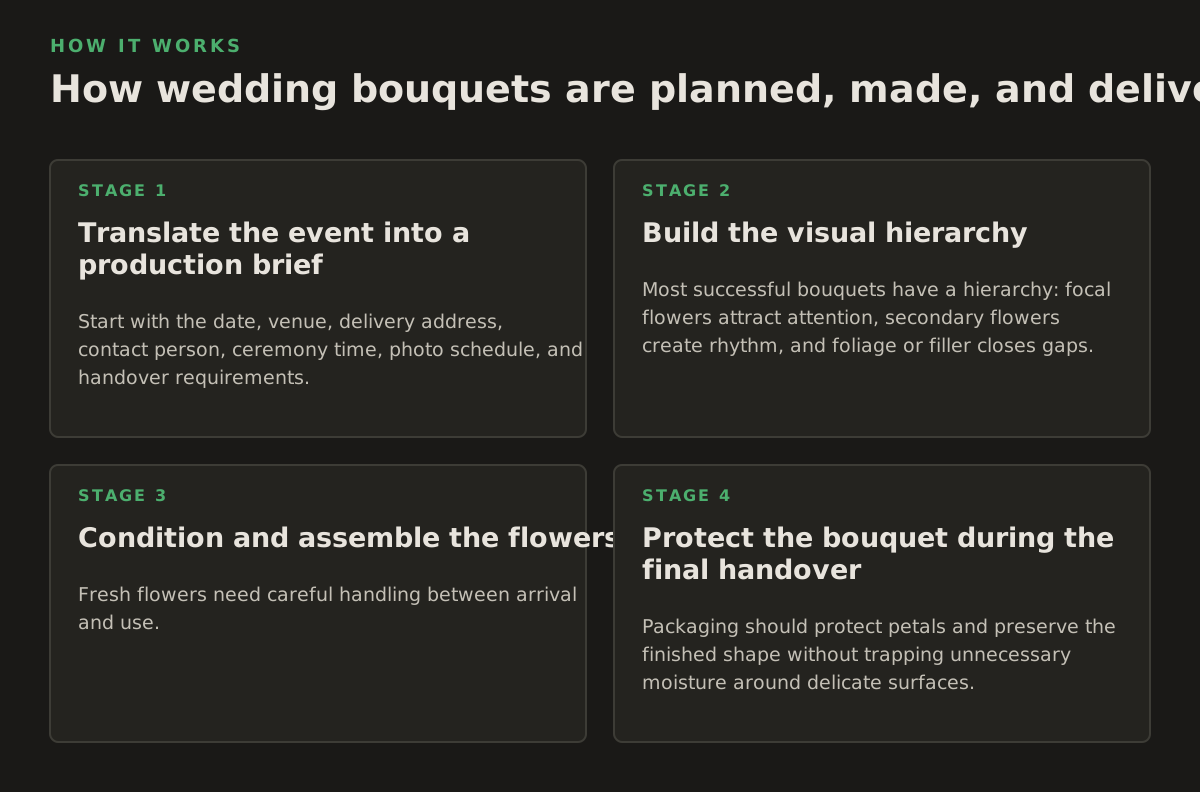
The process is a chain of decisions. A mistake early in the chain often appears later as a bouquet that feels wrong, even when the flowers themselves are healthy.
1. Translate the event into a production brief
Start with the date, venue, delivery address, contact person, ceremony time, photo schedule, and handover requirements. Add the bouquet type, approximate scale, preferred palette, dress details, ribbon preference, and any sensitivities. If several bouquets are needed, list each person separately rather than saying “bridal party flowers.” A bridesmaid bouquet may share the palette while being smaller or less elaborate.
Include the route between locations. A bouquet delivered to a hotel room may be handed over quickly, while one sent to a venue may need a named coordinator, loading instructions, or a specific room. Delivery information is part of the floral design because a delayed handover shortens the time available for conditioning and presentation.
2. Build the visual hierarchy
Most successful bouquets have a hierarchy: focal flowers attract attention, secondary flowers create rhythm, and foliage or filler closes gaps. Without hierarchy, every stem competes equally and the bouquet can appear noisy. With too much hierarchy, one oversized bloom can make the design feel top-heavy.
A useful brief can specify the hierarchy without prescribing every stem:
- Focal: one or two flower types that should be noticed first.
- Support: smaller blooms or repeated shapes that connect the focal flowers.
- Texture: airy, ruffled, smooth, spiky, or berry-like elements that create depth.
- Frame: foliage or trailing material that defines the outer edge.
- Handle: a finished grip that is comfortable, secure, and visually consistent with the outfit.
This structure also makes substitutions easier. If a preferred focal flower is unavailable, the florist can preserve the intended role with another suitable bloom rather than replacing it randomly.
3. Condition and assemble the flowers
Fresh flowers need careful handling between arrival and use. The Royal Horticultural Society advises keeping cut flowers away from heat, direct sun, and fruit, and recommends clean water and appropriate stem preparation in its cut-flower care guidance (RHS cut-flower care guidance, accessed 2026). Those principles matter even more for wedding work because the bouquet has a fixed public deadline.
For a hand-tied bouquet, stems are arranged around a central point so the outline, height, and weight remain controlled. The binding must hold the design without crushing stems. The handle is then wrapped and finished. A bouquet designed for extended carrying should not merely be beautiful from the front; it should remain stable when the wearer lowers it, changes hands, or holds it beside another person.
4. Protect the bouquet during the final handover
Packaging should protect petals and preserve the finished shape without trapping unnecessary moisture around delicate surfaces. The recipient should know which wrapping to remove, where to hold the bouquet, and whether it should be placed in water before use. If the bouquet is being delivered to a venue, the florist or coordinator should agree who is responsible for receiving it and keeping it in a suitable location.
For Singapore weddings, the indoor-outdoor transition deserves specific attention. Singapore’s climate is consistently warm and humid, while rainfall patterns can change across the year; the National Environment Agency describes the country’s climate and monsoon seasons in its official overview (Meteorological Service Singapore climate overview, accessed 2026). That does not mean every bouquet will fail outdoors, but it does mean the timing, shade, water access, and transport plan should be explicit.
Where bouquet plans break down
Most problems are not caused by a florist misunderstanding the word “romantic.” They come from hidden constraints, late changes, or a mismatch between appearance and use. The earlier those risks are named, the more options remain.
Heat, humidity, and long holding periods
Warm conditions increase the importance of shade, hydration, and timing. A bouquet left in a parked vehicle or placed beside a hot window has a different risk profile from one kept in an air-conditioned room. Outdoor portraits may also expose petals to wind and direct sun before the ceremony begins.
The practical response is not simply “use hardier flowers.” It may involve a later delivery, a shaded holding area, a water source until close to the ceremony, a second smaller bouquet for photographs, or a design with less exposed delicate material. The right choice depends on the schedule. A bouquet needed for ten minutes and one carried across a half-day event should not be specified identically.
Allergies, fragrance, and loose material
“Fresh” does not automatically mean comfortable for everyone. Ask about pollen sensitivity, strong fragrance, sap, thorns, and loose berries or dried fragments. If the wearer is sensitive, communicate that before flowers are selected rather than after the bouquet is assembled. Avoiding a problem may require changing the flower category, not just removing one visible bloom.
Fragrance also behaves differently in small indoor rooms and large outdoor spaces. A scented bouquet can feel pleasant during a short portrait session but distracting during a long ceremony. If the couple wants fragrance, describe the desired intensity and where the bouquet will be held.
Exact replicas and unavailable stems
Reference images are valuable for proportion, movement, palette, and mood. They should not be treated as a guarantee that every stem will be identical. Flowers can vary in size and colour, and availability may change by date. The best request distinguishes between “must preserve” and “can change.”
- Must preserve: overall silhouette, warm-white palette, low fragrance, compact handle, and airy spacing.
- Can change: one filler flower, a foliage variety, the exact shade of blush, or the number of secondary blooms.
- Must not include: thorns, very dark foliage, strong fragrance, or a cascading length that catches on the dress.
This approach protects the design intention while allowing a professional to make a sensible substitution. A rigid stem-by-stem demand can produce a less coherent result when one requested ingredient is unavailable.
Delivery timing and venue coordination
A delivery window is not the same as the time the bouquet is needed. Build a buffer for reception, inspection, minor adjustment, dressing, and photography. For an illustrative starting policy, a couple might ask for the bouquet to arrive before getting dressed rather than exactly at the ceremony start. That is a planning example, not a universal timing rule; the florist should advise based on the flowers, location, and event schedule.
Provide one primary contact and one backup contact. Confirm lift access, building restrictions, parking, and whether the bouquet is going to a room, bridal suite, ceremony hall, or coordinator. A beautiful arrangement can still fail its purpose if nobody authorised is available to receive it.
How practitioners apply the method to real wedding orders
The following examples show how the same design principles produce different solutions. They are illustrative starting points, not fixed packages or price promises.
Example one: a civil ceremony with limited holding time
The couple wants an understated look, has a simple outfit, and expects a short ceremony followed by nearby photographs. The appropriate direction may be a compact hand-tied bouquet with a clean handle, restrained foliage, and a few textural accents. The decision is driven by proportion and convenience rather than by the maximum number of flowers.
The brief should state the short route between ceremony and photographs, whether the bouquet must be placed on a table, and whether the couple wants a second arrangement for signing or reception décor. A small bouquet can then be intentional rather than merely “budget-sized.”
Example two: an outdoor solemnisation in warm weather
Here, the design must account for shade, wind, waiting time, and photographs. A loose bouquet may still be suitable, but the outer elements need secure placement and the delivery should be coordinated close to the time of use. A water source or cool holding area should be identified in advance.
The couple should tell the florist whether the bouquet will be carried continuously or set down between photographs. If the design will be held for a long period, a slightly more compact shape may be more practical than an extremely open arrangement. The choice is not about making the bouquet less beautiful; it is about preserving the intended appearance under the actual conditions.
Example three: a ballroom wedding with a dramatic gown
A large venue and structured dress can support more visual volume, but scale must still be tested against the wearer’s body. A bouquet with a clear focal area and controlled outline may photograph better than an arrangement where every flower extends in a different direction. The handle should be secure and comfortable because formal portraits often require repeated repositioning.
Ask for the stage backdrop, table colours, bridesmaid palette, and lighting description. Strong artificial lighting can make pale flowers disappear, while dark flowers may become visually heavy. A florist can adjust contrast through foliage, texture, and flower placement without abandoning the overall palette.
Example four: a wedding party with several bouquets
When ordering bridal and bridesmaid bouquets together, use a family resemblance rather than identical copies. The bridal bouquet can carry the main focal flowers or more movement, while bridesmaid bouquets repeat the palette at a smaller scale. Flower-girl designs may need shorter handles and lighter weight.
Prepare a table before ordering:
| Recipient | Design decision | Information to confirm |
|---|---|---|
| Bride | Main silhouette and focal flowers | Dress, height, ceremony duration, photo schedule |
| Bridesmaids | Smaller related versions | Number of attendants, outfit colour, holding comfort |
| Flower girl | Petite bouquet or alternative floral detail | Age, supervision, handle length, walking route |
| Groom or couple | Buttonhole or coordinating detail | Jacket fabric, placement, ceremony timing |
Example five: preserving the flowers after the wedding
If the couple wants a longer-lasting keepsake, decide that before the wedding rather than treating preservation as an afterthought. Fresh, dried, and preserved flowers behave differently and should be planned as separate products. A fresh bridal bouquet may be designed for the wedding day, while a preserved or dried arrangement may provide the lasting décor element.
Another option is to retain selected stems, ribbon, or a small secondary arrangement rather than trying to preserve the entire bouquet. That can reduce the conflict between a delicate wedding-day design and a durable keepsake. Ask what the couple wants to remember: the exact bouquet, the colour story, the handle wrapping, or a small framed detail.
What to ask before placing the order
A good consultation should end with a shared understanding of the design and the logistics. The customer does not need to know botanical terminology. They do need to communicate the decisions that affect the result.
- Date and location: include venue name, delivery address, access details, and the person receiving the flowers.
- Use schedule: state when the bouquet is needed, when photographs begin, and how long it may be carried.
- Design direction: provide mood words, palette, preferred shape, and reference images showing proportion rather than only individual flowers.
- Wearer details: share outfit colour, neckline, sleeve shape, height, and whether the bouquet must be very light.
- Sensitivities: identify allergies, fragrance concerns, thorns, sap, pollen, or loose materials to avoid.
- Flexibility: state which flowers are essential and which may be substituted while preserving the look.
- Aftercare: confirm how the bouquet should be held, stored, displayed, and handled after the ceremony.
For everyday celebrations around the wedding, the same planning logic applies to other floral needs. A congratulatory arrangement for a newly married couple can be designed for their home, while sympathy flowers or flower stands require different dimensions, messages, delivery access, and viewing conditions. Treating each order according to its job prevents the common mistake of applying bridal-bouquet assumptions to every occasion.
The most reliable recommendation is to place the wedding order as a complete brief: wearer, outfit, venue, schedule, palette, shape, sensitivities, delivery contact, and acceptable substitutions. That gives the florist enough information to protect the design when weather, availability, or timing changes. For couples planning fresh, preserved, dried, soap, faux, bridal, or customised arrangements in Singapore, Summer's Winter Florist can help translate that brief into the appropriate floral format through Summer's Winter Florist.
Authored with NotFair SEO


