

Funeral Flower Arrangements: A Practical Guide for Singapore Families and Senders
by Summers & Winters on Sep 15, 2026

Funeral flower arrangements are designed floral tributes sent to honour someone who has died and support the people grieving their loss. They may be a small bouquet, wreath, standing spray, casket spray, basket, table arrangement or a larger floral stand displayed at a wake, funeral service or memorial gathering.
Table of Contents
- What Funeral Flower Arrangements are meant to do
- Why the flower choice matters to the family
- How to order funeral flowers without creating delays
-
Where funeral flower orders commonly break down
- Failure point 1: The arrangement arrives at the wrong stage
- Failure point 2: The design is too large for the space
- Failure point 3: The message is anonymous or difficult to read
- Failure point 4: The order treats tradition as a shortcut
- Failure point 5: The sender expects flowers to solve a practical need
- How practitioners apply the choice to real Singapore occasions
- Make the recommendation specific, respectful and deliverable
The right choice is not simply the most expensive or dramatic design. It is the arrangement that suits the family’s customs, the venue, the relationship you had with the deceased, and the practical realities of sending flowers across Singapore. A thoughtful tribute should arrive on time, be easy for the family to identify, and express sympathy without creating another decision for them to manage.
What Funeral Flower Arrangements are meant to do
A funeral arrangement performs several jobs at once. It communicates condolences when words feel inadequate, marks your presence when you cannot attend, and gives the family a visible reminder that the deceased mattered to others. At a wake, the flowers also become part of the setting: they may stand near a portrait, at the entrance, beside the altar or around the service area.
The format matters because it determines how the tribute will be seen and handled. A hand-tied bouquet is personal and intimate, while a standing spray is easier for many visitors to notice. A wreath communicates ceremony and remembrance; a compact basket may be more suitable when the family has limited space or when the flowers are being sent to a home.
The main formats and their practical roles
- Standing flower stand: a freestanding display with a message board, useful when several visitors need to see who sent the tribute.
- Wreath: a circular design associated with remembrance and continuity, commonly placed near the casket, portrait or service area.
- Standing spray: a vertical or fan-shaped display that creates presence without requiring a table.
- Condolence bouquet: a hand-held arrangement that feels personal and may be sent directly to the family.
- Basket or box arrangement: a contained design that can suit a home, office or smaller memorial setting.
- Casket spray: a larger tribute selected in coordination with the family or funeral provider, because its placement and timing require more planning.
These labels describe design formats rather than strict rules. Florists may use different names, and a family may have a specific preference. If you are uncertain, ask the florist which format is most appropriate for the venue and whether the family has requested a particular style.
What a condolence tribute is not
A funeral arrangement is not a celebration display, a romantic bouquet or a general-purpose gift. That does not mean it must be colourless or severe. It means the composition should put respect, restraint and legibility ahead of novelty. Strong fragrance, loose petals, noisy packaging and oversized decorations can become inconvenient in a quiet space.
It is also not a substitute for checking the service details. In Singapore, funeral arrangements may involve different religious and cultural practices. The National Environment Agency provides information about post-death matters and funeral services, including the role of funeral arrangements and facilities; its guidance is a useful official starting point when you need to understand the administrative context rather than assume every wake follows the same pattern. Read the NEA’s funeral services information before making assumptions about venue or process.
Why the flower choice matters to the family
Families receiving sympathy flowers are often coordinating visitors, religious rites, venue access, photographs, transport and messages from many people at once. A good arrangement reduces uncertainty. The family should be able to recognise the sender, understand the sentiment, and place the flowers without having to telephone you for clarification.
Flower meaning can guide the tone, but it should not become a rigid code. White flowers may create a quiet, formal appearance; soft pinks can suggest tenderness; green foliage can add calm and structure; pale yellow or blue accents may suit a tribute to someone whose personality was gentle, cheerful or closely connected with nature. The most meaningful colour may be the deceased’s favourite colour, provided it remains appropriate to the family’s wishes.
Use the relationship to set the tone
| Relationship or situation | Practical direction | Message approach |
|---|---|---|
| Close family member | Consider a larger, personal design or a tribute incorporating a known favourite flower. | Use a direct expression of love, gratitude or farewell. |
| Friend or former colleague | Choose a formal wreath, stand or bouquet in restrained colours. | State your name and relationship so the family can place you. |
| Workplace or department | Select a visible stand or coordinated arrangement with a clear sender line. | Keep the wording collective, such as a team or company message. |
| Neighbour, client or acquaintance | A modest basket or bouquet is usually less imposing than a very large display. | Use a short, sincere condolence without making claims about the family’s feelings. |
| Unable to attend | Prioritise reliable delivery, a legible card and confirmation of the venue details. | Acknowledge that you are sorry not to be present and are thinking of the family. |
The message card is part of the arrangement, not an afterthought. “With deepest sympathy” is appropriate when you do not know what to write. If you knew the deceased, one specific sentence can feel warmer: “I will always remember her kindness to new colleagues.” Avoid lengthy explanations, religious language you are unsure about, or messages that ask the grieving family to respond.
Respect cultural and religious preferences
There is no universal funeral flower rule that applies to every Singapore wake. Some families may prefer particular colours, flowers or arrangement styles. Others may prefer donations, practical support or no flowers at all. If the funeral notice includes instructions, follow them even if a floral tribute was your original plan.
When you do not know the family well, ask one of these people before ordering:
- a close relative or the person listed as the contact;
- the funeral director or wake coordinator;
- a colleague who is helping the family organise visitors;
- the venue, if the family has authorised it to receive deliveries.
Do not treat a florist’s colour palette as proof of religious suitability. A floristry professional can suggest neutral options, but the family or funeral provider remains the best authority on customs. This is particularly important when you are sending on behalf of a company and want to avoid an avoidable mismatch between the display and the service.
How to order funeral flowers without creating delays
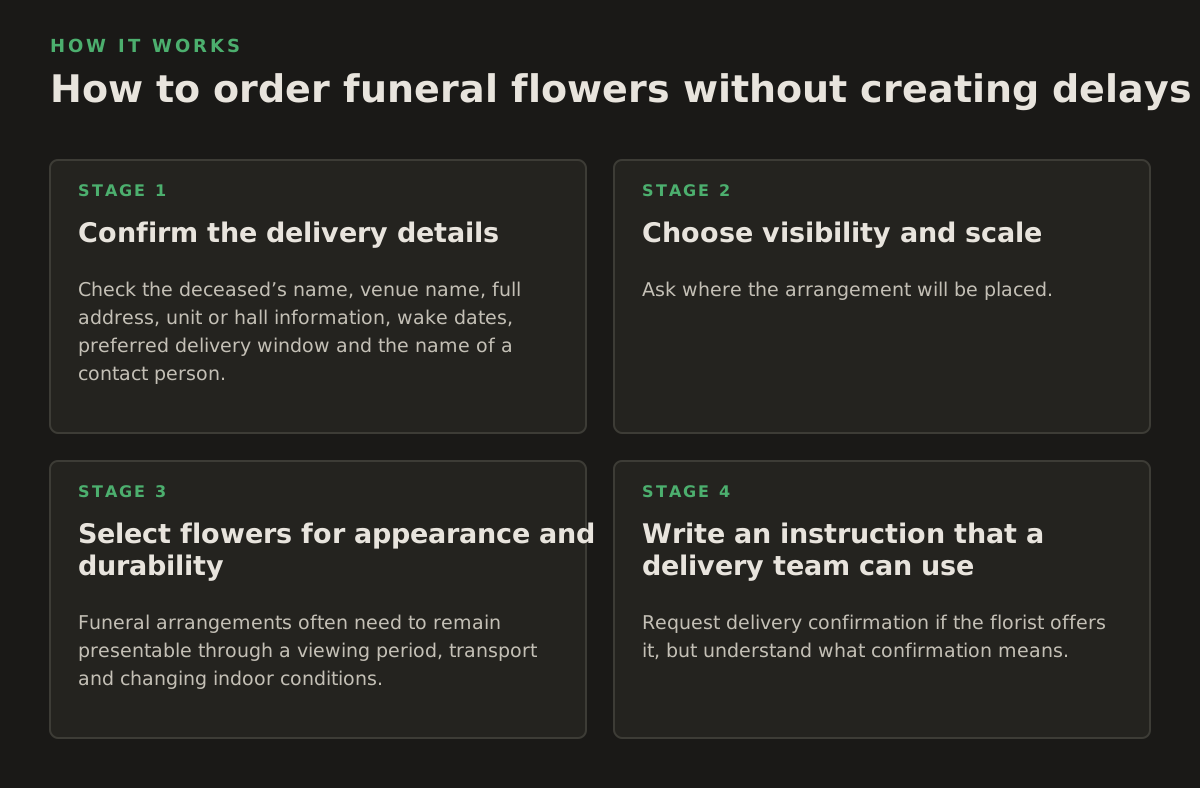
The ordering process should begin with information, not with scrolling through photographs. Before choosing a design, gather the wake details and decide whether you want the tribute to be intimate, visible from a distance, or coordinated with other family flowers.
Step 1: Confirm the delivery details
Check the deceased’s name, venue name, full address, unit or hall information, wake dates, preferred delivery window and the name of a contact person. Funeral venues can have multiple halls or floors. A florist may need to call the venue or family if the instruction is incomplete, and that can create stress when timing is tight.
If you are ordering from overseas or on behalf of a business, do not rely on a location pin alone. Include the written venue details supplied by the family. Singapore’s government guidance on what to do after someone dies explains why families may be handling several official and practical arrangements simultaneously; that is another reason to keep your message and delivery instruction concise. See Singapore’s official post-death guidance.
Step 2: Choose visibility and scale
Ask where the arrangement will be placed. A standing display is useful when it needs to be noticed among many tributes. A bouquet may be more suitable beside a portrait or for delivery to the family’s home. A very large design can be inappropriate if the venue is crowded, if the family has requested limited flowers, or if there is no safe place to position it.
As an illustrative starting policy, a company sending one tribute might choose a clearly labelled stand for a public wake, while a small group of friends might choose one shared bouquet with every sender named on the card. These are planning examples, not universal requirements. The family’s request and the venue’s capacity take priority.
Step 3: Select flowers for appearance and durability
Funeral arrangements often need to remain presentable through a viewing period, transport and changing indoor conditions. A florist should select flowers that are suitable for the requested format and delivery window, while allowing for seasonal availability. If a particular flower is unavailable, ask for a similar colour, silhouette or emotional tone rather than insisting on a fragile substitution.
For a home-delivered bouquet, basic care can extend its display life: use a clean vessel, keep the stems in fresh water, remove foliage below the waterline and place the flowers away from direct heat or strong sun. The University of Minnesota Extension gives practical cut-flower care guidance covering these fundamentals. Review its cut-flower care recommendations.
Step 4: Write an instruction that a delivery team can use
- Recipient: the deceased’s full name and, where useful, the family contact’s name.
- Destination: venue, hall, floor, unit or clearly stated address.
- Timing: the requested date and acceptable delivery window.
- Placement: entrance, reception, altar area or another authorised location.
- Sender: the exact individual, family, department or company name to print.
- Contact: a reachable phone number for clarification, not for a long conversation.
Request delivery confirmation if the florist offers it, but understand what confirmation means. It may show that the item reached the stated venue; it may not mean that a specific relative personally received it. That distinction matters when the family is moving between the wake, crematorium, religious service and home.
A worked example
Suppose three colleagues want to send flowers to a wake at a Singapore funeral venue. Their useful brief might read: “Please deliver a medium-height condolence stand to the main reception area on Tuesday afternoon. The deceased is Mr Tan Wei Ming. Card sender: The Product Team at Northbridge Pte Ltd. Contact: Elaine, 9XXX XXXX. Please call if the venue cannot accept stands.” This is more actionable than “Send something respectful to the wake.”
For a family member ordering from another country, the same principle applies: ask a Singapore-based relative to confirm the address, choose a delivery window that matches the wake, and use a message that identifies the sender clearly. A florist can make the arrangement beautiful; only accurate information makes the delivery dependable.
Where funeral flower orders commonly break down
Most problems are not caused by the flowers themselves. They come from a mismatch between the design, the venue, the timing or the family’s expectations. Spotting these failure points before ordering is more valuable than trying to fix them after delivery.
Failure point 1: The arrangement arrives at the wrong stage
A tribute delivered after the wake has moved or closed cannot fulfil its purpose, even if the flowers are fresh. This happens when a sender copies an old notice, confuses the wake date with the cremation date, or assumes that delivery can happen at any hour.
Prevent it by verifying the active venue and date on the same day you order. If the notice lists several events, identify which one should receive the flowers. When timing is uncertain, contact the family or funeral coordinator rather than asking the florist to guess.
Failure point 2: The design is too large for the space
A tall stand may look appropriate in a photograph but obstruct a narrow corridor, block signage or leave no room for visitors. Several employees may also send separate stands without realising that the family has limited capacity. A smaller, well-labelled design can be more considerate than a spectacular one.
Prevent it by asking about venue capacity and coordinating group orders. If several people are contributing, one shared tribute can carry every name while reducing clutter. This is especially practical for small offices, clubs and apartment-based wakes.
Failure point 3: The message is anonymous or difficult to read
Families may receive many flowers in a short period. A sender name hidden in a long paragraph or written in tiny lettering makes it difficult to know who has offered support. A company name without a department can be equally unclear.
Keep the card short and use the name the family will recognise. For example: “With deepest sympathy. From Aaron, Mei and the Customer Care Team at Lumen Pte Ltd.” If a tribute is sent by a large organisation, include the specific office, branch or team.
Failure point 4: The order treats tradition as a shortcut
Choosing white flowers automatically, copying a photograph from another funeral or adding religious symbols without confirmation can create discomfort. Neutrality is not achieved by guessing. It comes from asking a respectful question or selecting a simple design that does not make cultural claims.
- Do not assume that every family wants a wreath.
- Do not assume that every wake permits stands or large displays.
- Do not add religious wording unless the family uses it.
- Do not describe a colour as “correct” without knowing the family’s practice.
- Do not send a strongly scented arrangement when the venue or household may be sensitive to fragrance.
Failure point 5: The sender expects flowers to solve a practical need
Flowers communicate care, but they do not replace an offer of concrete help. If you are close to the family, a separate message offering transport, food, errands or attendance may be more useful. Keep that offer separate from the card so the floral tribute remains simple and the family does not feel obliged to respond immediately.
How practitioners apply the choice to real Singapore occasions
The best recommendation changes according to who is sending, where the flowers are going and what the sender knows about the family. Use the following scenarios as decision patterns rather than fixed rules.
For an individual sending condolences
If you are a friend, neighbour or former colleague, choose a format that matches your closeness without competing with the family’s own flowers. A compact bouquet or modest basket is personal. A standing tribute is useful when you want your support to be visible at the wake, especially if you cannot attend.
Use one clear sentence in the card. If you knew the deceased, mention a genuine quality or memory. If you did not, avoid pretending to know more than you do. “I am sorry for your loss. Thinking of your family during this difficult time” is safer than an elaborate message built around assumptions.
For a company, department or business partner
Businesses should prioritise clarity and coordination. Nominate one person to collect the venue details, confirm the sender wording and check whether colleagues are already arranging a group tribute. A company stand should look intentional rather than like several unrelated orders placed by different people.
A practical corporate brief includes:
- the approved company name and department;
- one authorised message for the card;
- the event date and venue contact;
- the person responsible for approving the design;
- whether the arrangement should be a stand, wreath or bouquet;
- the internal cost centre or reimbursement details, handled separately from the family’s message.
For a grand opening or congratulatory event, bright and celebratory flowers may be appropriate. For condolences, keep the company identity legible but subordinate to the purpose of the tribute. A restrained arrangement with a clearly printed sender line usually serves better than a branded display that feels promotional.
For a family member choosing a personal tribute
Family members can make the arrangement more meaningful by sharing a small detail: a favourite flower, a garden the deceased loved, a preferred colour, or a meaningful shape. That detail can guide the florist without requiring an elaborate theme. A single recognisable flower repeated through a design may say more than a crowded mix of unrelated blooms.
Coordinate casket flowers and venue displays with the funeral director or service organiser. The family may already have selected a colour palette or placement plan. If several relatives are ordering separately, agree on who is handling the principal tribute and which additional flowers will support it.
For a sender who wants something that lasts
Fresh flowers are usually the natural choice for a wake or funeral service because they convey presence at a specific time. Preserved or dried flowers can be considered for a later memorial, a home display or a keepsake, but they are not always suitable for a venue that expects fresh floral tributes. Soap flowers and faux flowers may be appropriate as decorative gifts in other situations, yet they can feel less fitting when the family has requested fresh arrangements.
Ask what the family wants to do after the service. If the flowers will be taken home, choose a manageable size and a container that is easy to move. If the family has little storage space, a smaller arrangement or a card expressing support may be kinder than a large display that must later be dismantled.
A decision checklist before you place the order
- Have I confirmed the current wake venue, date and delivery window?
- Does the family permit or welcome flowers?
- Is the chosen format suitable for the available space?
- Will the sender name be immediately recognisable?
- Does the message express sympathy without asking the family to respond?
- Have I avoided unverified religious or cultural assumptions?
- Is there a reachable contact if the venue or timing changes?
- Would one coordinated tribute be better than several separate displays?
For a public wake where visibility matters, consider flower stands with a concise message and clear sender line. For a personal condolence sent to a home or close relative, explore flower bouquets and ask for a design scaled to the recipient’s space rather than choosing the largest option by default.
Make the recommendation specific, respectful and deliverable
A dependable funeral flower order brings together four decisions: the right format for the venue, a tone that fits the relationship, accurate delivery information and a message the family can identify. When those four elements agree, the flowers can be quiet, formal, colourful or highly personal without losing their purpose.
For most uncertain cases, begin with a modest wreath, standing arrangement or bouquet in restrained colours, then adjust it after confirming the family’s preferences. If you are ordering for a company, coordinate names before the florist prints the card. If you are close to the family, ask whether flowers, a practical gesture or a specific tribute would be most welcome.
Summer's Winter Florist offers fresh bouquets, condolence displays and custom floral arrangements for Singapore deliveries; browse Summer's Winter Florist when you are ready to discuss a tribute suited to the family, venue and timing.
Authored with NotFair SEO


